Thursday, February 23, 2017

Mockingbird Canyon Rock Art

Mockingbird Canyon is a former Luiseno habitation site in Riverside County. The site contains pictographs, a "yoni" (that I didn't see), several morteros, and a "Shaman's Cave. It also has a solstice component. Unfortunately, it was unprotected for decades, and every idiot in the area with a can of spray paint seems to have left their mark there.

A nice boulder pile near the site.

Much of this site is overgrown with plants that you wouldn't want to walk through wearing shorts. Of course, I was wearing shorts. The scabs should be gone in a few more days. On the other side of these rocks...

were these mortars.

There was supposed to be some pictographs very close to the mortars. I found nothing that stood out, and thought they might have totally deteriorated.

When I got home, I enlarged my photos looking for any traces of the pictographs. In the vertical orange streaks, I saw a couple of tiny red lines.

When I used DStretch to enhance the colors, some pictographs were revealed. Maybe some of you will recognize (from several prior posts here) the diamond shaped chains, that are part of female puberty initiate rites. If you have the time or inclination, go Here and Here and Here.


There are also several more mortars along this pretty stream, that is adjacent to the village site. I searched several boulder jumbles on the other side, but found nothing of note.

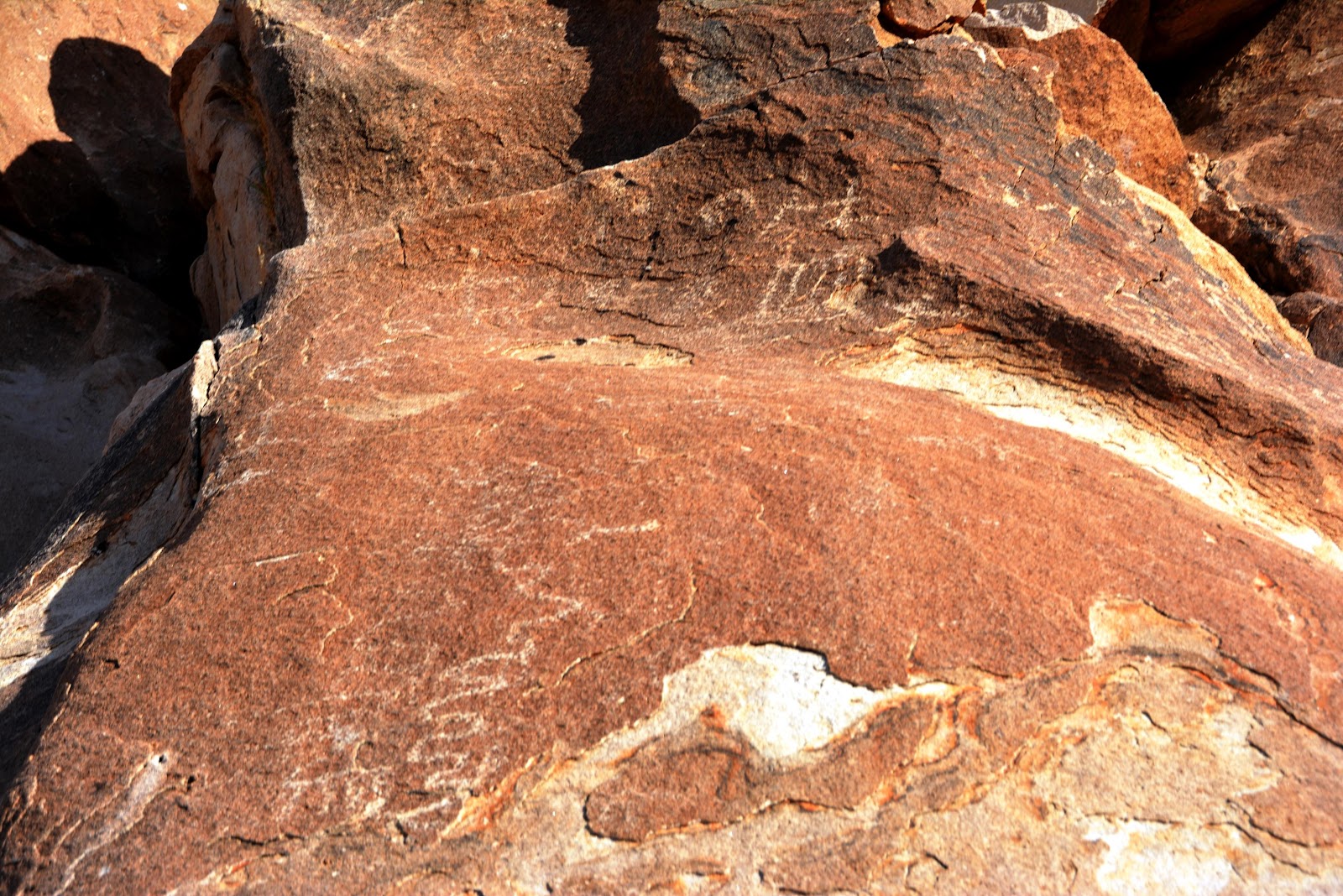
Back on this side of the stream, this rock seemed a likely spot for some pictographs.

Except for the fact that it was covered with graffiti. I HATE that people do this. The penalty should be much harsher than it is now (which is almost nothing).

I used DStretch and all available color variations to try to find something.

Look just to the right of the vertical red streak in the middle. It sure caught my eye!

Ta-Dah! Those are definitely pictographs (in the middle). Red vertical and horizontal shapes  falling down to a horizontal design. A little lower, you can see some "zig-zag" shapes in red.

The little spot of blue in the middle, is the "Solstice" component. Apparently, during one of the equinox events that take place every year, light shines through that hole and onto a particular spot or symbol. When that happens, it marks the beginning of change in season.

Below the opening, is the "Shaman's Cave." That is where the good stuff is.

It was quickly apparent, that this wasn't the actual opening, but I could still see some white pictographs on the roof.


This "DStretch" enhanced photo came out pretty good, considering my long lens. I climbed back down, and walked around to the other side to see what I hoped was the actual entrance into the cave.

This (and the  next four photos)  are the ceiling above the actual opening and cave. 


When I finally got to these fantastic pictographs. I couldn't get far enough away from them, to take anything but photos of small areas. I believe that this is a solstice site. However, when I look at the designs in the last two photos,  I see fish, and I see fish nets!

On the top of this big flat rock, I thought I saw petroglyphs. Nope! Graffiti!


Monday, February 13, 2017

The Best Odd Shaped Boulder in Joshua Tree

Over the years I've posted photos of boulders that look like just about every animal I can think of. Here is a new one. To me, it's the best one I've ever seen. I can't even really describe it properly.
The hairdo, beard, eyebrows, and nose are great. The whole face is comical. I'm trying to ignore the rear end...


Tuesday, January 31, 2017

Keyhole Canyon Southern Nevada

Keyhole Canyon is located in Southwestern Nevada. Not only is it a fantastic rock art site, the geology there is also amazing.


We are going to those distant mountains.

 Getting closer

Keyhole Canyon is straight ahead. It should be described as a "box" canyon because that is what it is. One way in, and one way out.

PLEASE EMBIGGEN THIS PHOTO!
I'm starting from the far end of the canyon, because that is where this AMAZING dry waterfall was. I had my wife get into the photo for scale. From bottom to top (that disappears into the sunlight) it was easily 10 stories tall. The front of the canyon is 20-30 yards wide, but it narrows quickly, and we had to squeeze into the last part.  All of the white stone going up the falls, has been worn as smooth as glass. 

 In the center of the photo you can see my wife. She is very close to the VERY narrow opening leading to the main part of the canyon. Nobody knows why, but there are no petroglyphs at all in this area. Just past the narrow opening, there are many of them.

This is one of the first groupings of petroglyphs outside the Cathedral area. Most noteworthy of this group is the row of lateral grooves running up the middle of the rock. As you can clearly see, they look like they are eroding away. They are not! The creator of the petroglyph, did it on purpose. It is called "edge abrasion." Some archaeologists believe that this effect, is always near a location (usually a rock shelter) used for "puberty initiate" fasting. 

 Just inside the canyon mouth was a rock shelter that contained this awesome boulder.


In addition to this single mortero (mortar), there are at least a hundred cupules ground into the stone. Many archaeologists consider "cupules" to be the earliest form of "rock art."  Based on this boulder, I'm thinking this place was used more for ceremony, than for habitation. There has certainly been a lot of water here, but that was probably many thousands of years ago. 

Many of the petroglyphs in this canyon are thousands of years old. There are several layers in some parts. This panel is one of them. What is cool about it (to me anyway) is the presence of big horn sheep and the symbol in the middle. See a close up in the next photo.


This "stylized" human figure is called an "anthropomorph." (ascribing human form or attributes to something that is not human). There are also a couple of big horn sheep in the panel. This symbol (a human with horns) most likely represents a Shaman and his "helper" animal. Or not...

 To me, this symbol looks like a some type of abstract big horn sheep (or two). 


These large geometric symbols have been associated (by archaeologists) with the "creation mythology" associated with the Pueblo/Anasazi, Paiute, and Mojave tribes, that have all been associated with this area.


 Big horn sheep

 A variety


 Is it just me, or is that a clown face in the upper middle? Clowns are scary and I hate them...


Many big horn sheep


.